


How to Choose an AI Data Solutions Partner: 7 Criteria Before Outsourcing
The most successful artificial intelligence (AI) implementations are built on expert-driven data solutions that power the world’s most advanced AI systems. Many AI systems are built on a strong data foundation, from document classification systems that automatically sort incoming correspondence, chatbots that answer customer inquiries, scheduling autonomous agents that optimize meeting arrangements, and data entry automation that extracts information from forms.
As models grow in complexity, the quality, scalability, and regulatory compliance of data are essential; therefore, sourcing from a vendor will play a significant role in system performance, regulatory compliance, and timely deployment.
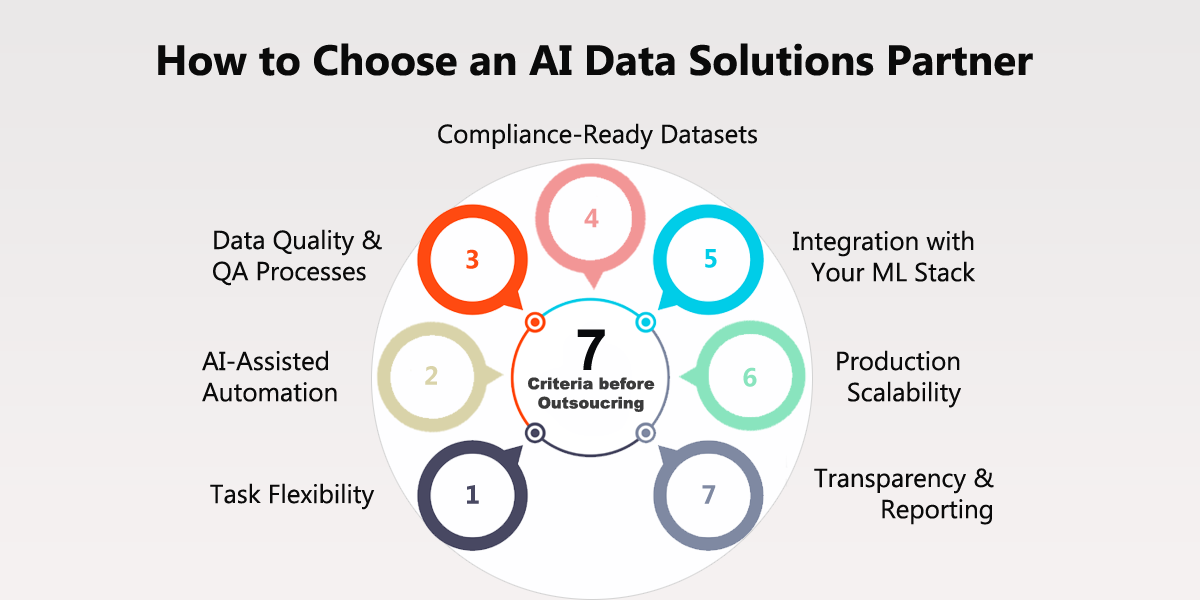
If you’re evaluating an AI data solutions partner, here are seven critical criteria to guide your decision that can make or break long-term success.
Before you choose a provider for data labeling solutions, here are 7 criteria your ML team needs to test operational readiness before handing your data over to someone else.
1. Task Flexibility
Can your vendor support different annotation methods? It can involve bounding boxes, named-entity recognition for text-based data, emotion recognition, and sentiment tags; it might also involve multimodal data needs for 3D point clouds, RLHF, fine-tuning of LLMs, or highly nuanced services.
In such cases, you need to ask vendors directly: What annotation types do you support natively? What have you done in our industry vertical?
Each vendor typically has strengths in certain types of annotation tasks and can be weaker in others (e.g., image annotation for retail vs. medical imaging vs. sensor fusion for autonomous vehicles). Look for vendors that have done similar work in the past and review samples of their work. It is important to request a review of sample case studies to validate their experience with your AI project needs.
2. AI-Assisted Automation
Can they reduce data-driven errors and biases? Manual-only labeling becomes inefficient at scale, making AI-assisted annotation with human validation a more effective approach.
Ask them: What percentage of annotations are AI-assisted, and also look at the factor of whether they balance automation with human review. It is because automation without oversight is dangerous in critical applications like healthcare AI and autonomous systems. Thus, look for vendors who can demonstrate measurable throughput improvements from automated workflows.
3. Data Quality & QA Processes
Bad labels are worse than no labels because they introduce biases into your dataset that are difficult to identify before training begins and often more problematic to correct afterward. This is why it is important to ask the vendor about the quality assurance process, e.g., annotator accuracy tracking, consensus scoring, and inter-annotator agreement (IAA) metrics) so that you can continually benchmark an annotator’s performance over time.
4. Compliance-Ready Datasets
Does their annotation process hold up under scrutiny? Domain-specific datasets for industries such as healthcare, finance, legal, or government must comply with internal standards and external regulations. HIPAA, GDPR, SOC 2, ISO 27001, and more are some compliance frameworks relevant to data usage. Thus, it is another question you need to ask the vendor: Are they certified to handle data residency requirements?
This isn’t just about security checkboxes. It’s about data lineage, consent documentation, and PII/PHI handling. Compliance matters to internal stakeholders as much as to data labeling service providers. Legal and procurement teams increasingly scrutinize where training data goes, who touches it, and how it’s stored. A client who treats compliance as an afterthought will create headaches for your whole organization — not just your ML team.
5. Integration with Your ML Stack
A partner offering high-quality training data integrates with your existing MLOps pipeline. Ask: How does data flow in and out of your platform? What’s the format of the output? How do we manage datasets across iterations?
By choosing data labeling solutions, you can ensure that the best partnerships feel like an extension of your own team’s workflow. Data shouldn’t need to be manually exported, reformatted, and re-uploaded every time you need a new batch. If you’re spending engineering hours managing the handoff, that’s a sign the integration story isn’t strong enough.
6. Production Scalability
Can They Grow With Your Demand Spikes? AI projects are unpredictable; at one time, you might need 10,000 annotations in a week and 500,000 next month before a major training run. Or you might need to spin up a completely new task type with 48 hours’ notice.
If your model needs to perform across regions, accents, or languages, your annotation pool should reflect that. Ask vendors: What’s your peak capacity? How quickly can you onboard annotators for a new task type? What’s your SLA for turnaround time?
Some vendors look great for small pilots but fall apart at scale. Others have the workforce capacity but can’t maintain quality when ramping up quickly. You want a partner who has both — documented capacity and a clear process for maintaining quality standards when volume increases.
7. Transparency & Reporting
Do You Have Visibility Into What’s Happening? This one gets overlooked. ML teams often hand off data, wait for delivery, and only realize there’s a problem when they start training. By then, it’s expensive to fix.
A strong data partner gives you real-time project visibility — annotation progress dashboards, quality metrics, and clear communication when something unexpected comes up in your dataset.
Ask: What does your project reporting look like? Can we see annotator-level performance? How are ambiguous or edge-case annotations escalated?
Transparency in partnership goes beyond simple “scorecards” or “quality metric” to honest discussions about the project’s scope, its delivery timelines, and the complexity of the underlying data. For you to receive honest and fair partnership treatment from your vendor and for them to manage you properly, you need visibility into both performance metrics and potential issues to ensure continuous improvement.
The Bottom Line
Outsourcing your data labeling is a strategic decision, not just a procurement exercise. Your model is only as good as the data it trains on, and your data partner has direct influence over that.
The vendors who earn long-term partnerships are the ones who ask hard questions before they start, show their work during the project, and treat your model’s performance as their own KPI.
Use these seven criteria to find what truly matters when finding a partner your ML team can actually rely on.
Because the right data partner doesn’t just label your data, but they help you build better AI models, faster and more reliably.


Post Comment