



Object Detection: Concepts, Mechanisms, and Modern Applications
The algorithms in object detection utilize machine learning or deep learning for producing fruitful results. Just as humans are able to recognize and spot objects of interest within an image or video in seconds, object detection strives to replicate this same capability via a computer. It is the primary technology in advanced driver assistance systems (ADAS) enabling cars in detecting driving lanes or performing pedestrian detection for enhancing road safety. It is also useful in applications like video surveillance or image retrieval systems.
Object detection is a combination of two subtasks – object localization and object classification. The former is a technique used for determining the location of particular objects in an image through demarcation of objects using a bounding box. The latter involves determining the category a detected object belongs to.
Understanding Object Detection
Object detection combines two primary components — object localization and object classification.
- Localization determines where an object is located within an image, typically by enclosing it in a bounding box.
- Classification identifies what the object is — for example, distinguishing between a pedestrian, vehicle, or traffic sign.
The goal is to replicate human visual perception by enabling computers to interpret and understand visual data in real time.
Working of Object Detection
Object detection is carried out using two distinct data analysis techniques; image processing and deep neural network.
1. Image processing: This algorithm is used for analysing images for detecting objects based on certain key features like edges or textures. It involves application of a range of image processing techniques including filtering, threshholding, and segmentation for extracting regions of interest in the image. Further analysis of the regions is carried out to determine if they contain an object or not. Image processing can be used for unsupervised learning as it does not require labeled training data.
2. Deep neural network: It requires algorithms to be trained on a wide range of labelled datasets for detecting objects. It utilizes convolutional neural network (CNN) architecture, a deep learning algorithm designed to analyse images. CNN learns how to detect objects through feature analysis of the image at various levels of abstraction by utilizing many layers of artificial neurons for performing complex analyses. Performing object detection using deep neural network involves training the network with a dataset of labelled images. Each image consists of one or more images and is annotated with a bounding box. The trained network is used for detecting objects in new images by passing it through the network with the output being analyzed.
Role of Object Detection in Key Applications
Object detection plays a key role in applications like video surveillance, autonomous vehicles, robotics, image retrieval, and augmented reality through identification and localization of images or videos. Given below is the list of industries along with where object detection is beneficial.
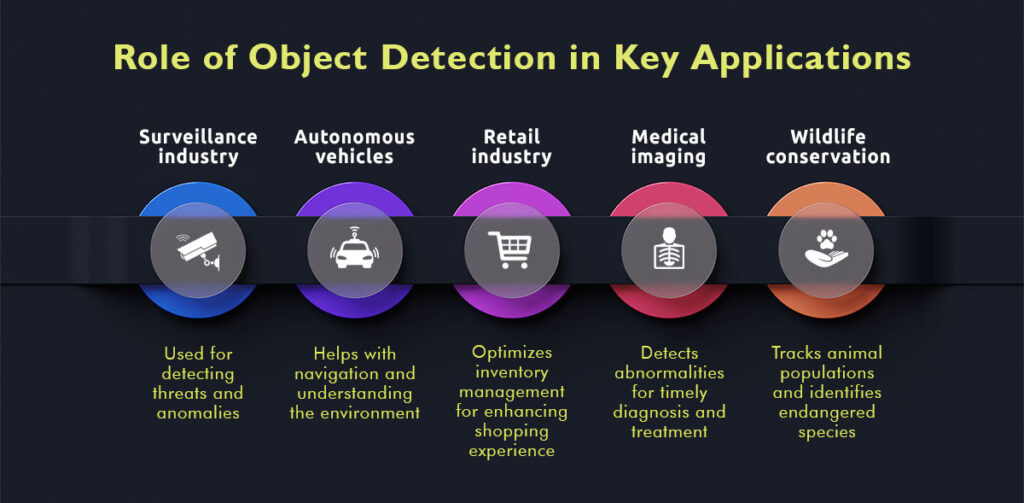
1. Surveillance Industry: The use of advanced cameras and sensors enable object detection algorithms to analyse video feeds in real time. It assists in identifying objects and movements that can be potentially threatening. It involves instant detection of danger through highly advanced lie detectors. Object detection enables security personnel to quickly and accurately respond to possible threats similar to the way a highly skilled team of agents can quickly neutralize a threat. It is helpful in ensuring high-security facilities like government buildings, research labs and financial institutions are protected and secure.
2. Autonomous Vehicles: Object detection enables self-driving cars to see, analyse and make decisions based on everything that’s happening around them. It utilizes cameras, lidar, radar and other sensors to identify and track various objects on the road. The algorithms not only identify objects but also gauge its size, speed and trajectory. This permits vehicles to predict movements and make decisions.
3. Retail Industry: In the retail industry, object detection is used for instantly identifying products in an image and offer customers with relevant information. It is especially useful in online shopping to assist customers in quickly look for items by simply typing in the keyword or phrase. It is also utilized for analyzing customer behavior. The analysis of images of customers helps retailers in gaining an insight regarding which products are being searched by customers and the ones they will most likely purchase. This assists retailers in creating targeted marketing campaigns and enhancing the customer experience.
4. Medical Imaging: Object detection utilizes advanced machine learning techniques for sifting through medical images and highlighting any anomalies present like tumors or lesions. Through early identification of possible health issues, doctors are able to provide targeted and effective treatment plans for their patients.
5. Wildlife Conservation: Object detection utilizes advanced algorithms along with machine learning techniques to enable researchers and conservationists to instantly and correctly survey large portions of land, identifying various species of animals and plants and monitor changes over time. Apart from recognizing various species, object detection in satellite imagery can also be utilized for tracking movements of migratory species like birds and fish.
Emerging Trends and Future Outlook
The future of object detection is shaped by three major trends:
- Edge Deployment and Real-Time Processing:
With advances in edge computing, object detection models can now run on smartphones, drones, and IoT devices, enabling faster, localized decision-making without cloud dependency. - Generative and Multimodal Models:
Integration with generative AI and vision-language models (like CLIP or GPT-4V) enables more context-aware detection — systems that can not only locate an object but also describe its function or relation to the environment. - Augmented and Extended Reality (AR/XR):
Object detection forms the backbone of AR applications, allowing interactive overlays in industrial training, maintenance, and education. As AR devices evolve, object recognition will become increasingly seamless and intuitive.
Conclusion
In the coming years, one can expect to see new technologies and techniques that will enhance the efficiency of object detection systems and make them operational in real-time under challenging and complex scenarios. Also, augmented reality (AR) technology is another key technology that one can see in the coming years. Through remote visual support, training and maintenance, technicians and engineers will be able to be in receipt of training and support from any part of the world. This will further enhance the scalability and efficiency of object detection systems. Hence, with continuing advancements in computer vision and AR, object detection can offer endless possibilities.

Post Comment